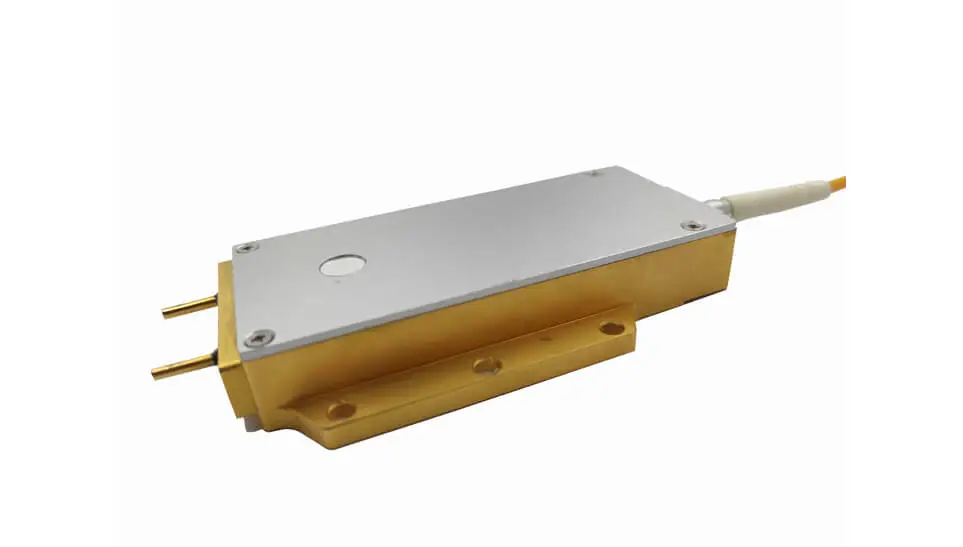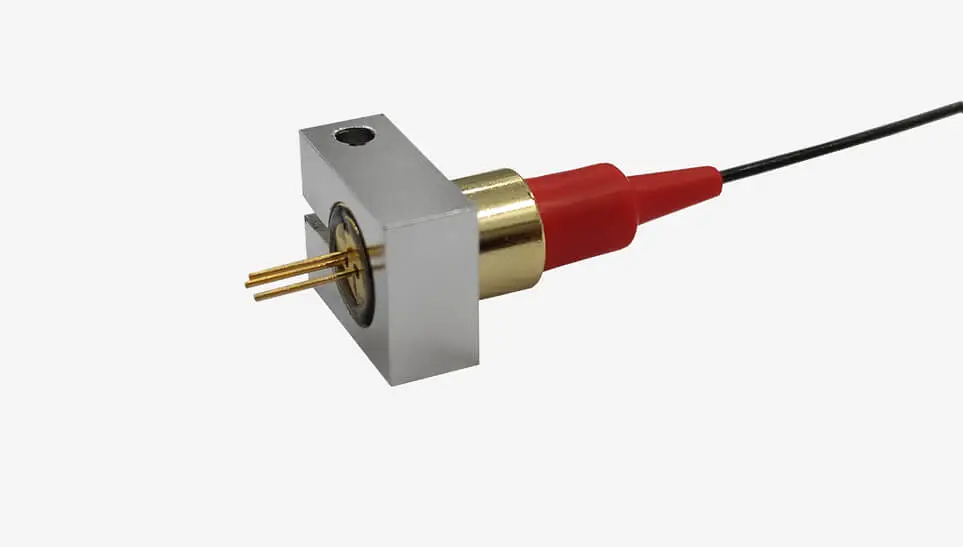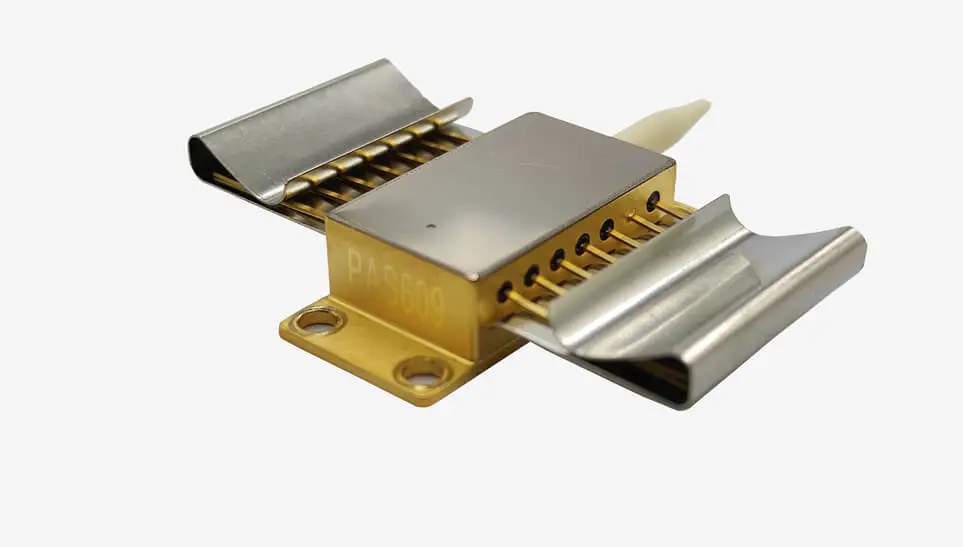
A fiber coupled laser diode module can simplify light delivery in spectroscopy and sensing instruments by separating the laser source from the sampling location. Instead of aligning a free-space beam through several optical components, engineers can route the output through a flexible fiber to a probe, sample chamber, interferometer, or detector assembly.
However, the correct module cannot be selected by wavelength and output power alone. Spectral linewidth, wavelength stability, fiber type, numerical aperture, coupling efficiency, connector format, thermal control, and modulation requirements all influence system performance.
Photonstream provides fiber-coupled laser diodes in single-mode, multimode, polarization-maintaining, butterfly, TO-can, and multi-emitter configurations across a broad wavelength range.
The required wavelength is determined by the sample, target molecule, detector response, and spectroscopy technique.
Common applications include:
Fluorescence excitation
Raman spectroscopy
Absorption spectroscopy
Gas sensing
Particle detection
Biomedical analysis
Environmental monitoring
Optical calibration
In fluorescence measurements, the laser wavelength must overlap the absorption band of the fluorophore while allowing the emitted signal to be separated by filters. For absorption sensing, the laser should correspond to a useful absorption feature of the target material.
A fiber coupled green laser may be suitable for fluorescence excitation, microscopy, and selected Raman systems. However, green excitation can produce strong background fluorescence in some materials. A longer wavelength may reduce fluorescence, while a shorter wavelength can increase Raman scattering strength but may also raise the risk of sample damage.
Lasers are widely used in spectroscopy because they provide concentrated, coherent, and spectrally controlled illumination. Photonstream supports spectroscopy applications including UV-visible, infrared, Raman, and fluorescence measurements.
The laser’s rated output is not necessarily the power reaching the sample. Optical energy may be lost through the internal coupling optics, fiber, connector, filters, collimators, and probe components.
The power specification should therefore begin with the required sample illumination.
| Selection Item | What Engineers Should Confirm |
|---|---|
| Required sample power | Optical power needed at the measurement point |
| Fiber output power | Power available after internal coupling |
| System transmission | Losses through connectors, filters, lenses, and probes |
| Operating mode | Continuous-wave, pulsed, or modulated |
| Sample sensitivity | Risk of heating, bleaching, or optical damage |
| Detector range | Minimum useful signal and saturation limit |
A higher-power source does not automatically improve measurement quality. Excessive illumination can heat the sample, saturate the detector, increase stray light, or accelerate photobleaching.
The module should provide enough margin to overcome system losses without forcing the laser to operate continuously at its maximum rating.
Fiber type affects beam quality, power capacity, alignment tolerance, and compatibility with downstream components.
Single-mode fiber is often preferred when the system requires:
A stable spatial mode
A small focused spot
Efficient coupling to interferometers
Predictable beam propagation
High-resolution optical sensing
Compatibility with single-mode fiber components
The output can generally be collimated or focused more predictably than light from a large-core multimode fiber. However, laser diode to fiber coupling is more demanding because the small fiber core and numerical aperture create tight alignment tolerances.
Multimode fiber may be selected when higher power, easier coupling, or a larger illumination area is more important than diffraction-limited beam quality.
Typical uses include:
Broad sample illumination
Industrial sensing
High-power excitation
Large-area fluorescence
Systems with less restrictive beam-quality requirements
Photonstream’s fiber-coupled laser range includes single-mode products, multimode single-emitter devices, and multi-emitter modules for different power and beam-delivery requirements.
Polarization-maintaining fiber may be required when measurement results depend on a stable polarization state. Examples include polarization-sensitive spectroscopy, interferometry, certain fiber sensors, and systems using polarization-dependent optical components.
The complete optical path must maintain the required polarization alignment. Using a PM fiber does not guarantee stable polarization if the connector key, coupling axis, or downstream components are incorrectly oriented.
Efficient laser diode fiber optic coupling requires the laser beam to match the fiber’s core size, numerical aperture, and mode profile.
A laser diode usually produces an asymmetric beam with different divergence in the fast and slow axes. Coupling optics reshape and focus this beam into the fiber entrance. Misalignment, unsuitable lenses, or incorrect focal positioning can reduce transmitted power and direct energy toward the cladding or package.
Important coupling factors include:
Laser emitter dimensions
Fast- and slow-axis divergence
Fiber core diameter
Fiber numerical aperture
Lens focal length
Working distance
Axial and lateral tolerances
Thermal movement of the assembly
For single-mode systems, coupling efficiency should be evaluated together with output mode quality. A configuration that produces high measured power but excites unwanted modes may not provide the required beam characteristics.
The output should also remain stable after temperature cycling, vibration, and normal cable handling. Initial coupling efficiency is less valuable when alignment changes during operation.
Spectroscopy applications can place strict requirements on spectral performance.
A broadband fluorescence system may tolerate greater wavelength variation than a gas-absorption sensor targeting a narrow spectral feature. Depending on the measurement, engineers may need to specify:
Central wavelength
Wavelength tolerance
Spectral linewidth
Side-mode suppression
Wavelength drift with temperature
Wavelength drift with drive current
Long-term wavelength stability
Laser diode wavelength is affected by both current and junction temperature. Stable drive current and thermal control are therefore important for repeatable measurements.
A thermoelectric cooler and temperature sensor may be integrated into butterfly-packaged modules when greater stability is required. Simpler TO-can configurations may be appropriate for compact instruments with less demanding thermal requirements.
Many optical sensing systems modulate the laser so that the detector can distinguish the measurement signal from ambient light and low-frequency drift.
Before selecting a module, confirm:
Required modulation frequency
Analog or digital modulation
Modulation depth
Rise and fall times
Driver bandwidth
Relative intensity noise
Triggering and synchronization requirements
A module suitable for steady fluorescence excitation may not support the modulation speed required for lock-in detection, time-resolved measurements, or scanning spectroscopy.
Laser noise should also be considered relative to detector noise and the expected signal level. In low-light sensing, power stability can be more important than maximum optical output.
Photonstream offers fiber-coupled devices in several package formats, including TO coaxial assemblies, planar TO configurations, butterfly packages, and multi-emitter modules.
The package should match the instrument’s:
Available installation space
Thermal-management system
Electrical interface
Required optical power
Service and replacement method
Environmental conditions
Engineers should also specify the fiber length, jacket, connector type, bend-radius requirements, and output-end geometry. FC, SC, SMA, or other interfaces may be used depending on the power level and connected optics.
Connector repeatability matters when modules will be replaced or disconnected regularly. End-face contamination can increase loss and measurement variation, so protective caps and an inspection procedure should be included.
A complete request should include:
Spectroscopy or sensing method
Target wavelength
Required sample power
Single-mode, multimode, or PM fiber
Core diameter and numerical aperture
Linewidth and wavelength-stability requirements
Continuous or modulated operation
Package preference
Connector type and fiber length
Operating temperature
Required quantity
Testing and documentation requirements
These details allow the optical source, coupling structure, fiber, package, and thermal design to be evaluated as one system.
A fiber coupled laser diode module couples the output of a semiconductor laser into an optical fiber. The fiber provides flexible beam delivery and allows the laser source to be installed away from the measurement or illumination point.
The required wavelength depends on the absorption, fluorescence, reflection, or sensing characteristics of the target material. Buyers should define the target wavelength range, required spectral width, output power, and detector compatibility before selecting a module.
Single-mode fiber supports a smaller core and more controlled beam profile, making it suitable for applications requiring precise focusing. Multimode fiber can accept and transmit higher optical power but generally produces a larger and less uniform output mode.
Polarization-maintaining fiber is suitable when the instrument depends on a stable polarization state, such as interferometry, polarization-sensitive spectroscopy, and certain precision sensing systems. Standard single-mode fiber may be sufficient when polarization is not critical.
Laser diode to fiber coupling is influenced by the emitter size, beam divergence, lens design, alignment accuracy, fiber core diameter, numerical aperture, end-face quality, and mechanical stability of the assembly.
Yes. We can evaluate wavelength, output power, fiber type, core diameter, numerical aperture, connector, package, cable length, and thermal-control requirements for a custom fiber coupled green laser or other fiber-coupled laser configuration.
Choosing a fiber-coupled laser source for spectroscopy or optical sensing requires coordinated consideration of wavelength, sample power, fiber type, coupling efficiency, spectral stability, modulation, and packaging. The most suitable module is the one that provides repeatable optical performance at the measurement point—not simply the highest power at the laser package.
Photonstream supplies customizable fiber coupled laser diode module solutions covering single-mode, multimode, polarization-maintaining, TO-can, butterfly, and multi-emitter configurations. Wavelength, power, fiber specification, connector, package, and cable design can be developed around the intended spectroscopy or sensing system.
 Call us on:
  Email Us:
  2F, BLDG 6, #168, Changshan IZ, Liulian, Pingdi, Longgang District, Shenzhen, China
  EN
EN
 jp
jp  ko
ko  fr
fr  de
de  es
es  it
it  ru
ru  pt
pt  ar
ar  pl
pl